

173rd Airborne Brigade


Recruit

Description
Applicants who are 18 years of age are placed into the Delayed Entry Program for 30 days where they are observed by their Chain of Command to assess their maturity and potential. Applicants will still follow the same enlistment procedures as those of the Private Trainee, except they wait for promotion to Private Trainee upon the recommendation of their Chain of Command at the end of the Delayed Entry Program.
Private-Trainee
Description
The E-1 Private Trainee (PVT) is the entry level rank/grade. Enlistees are given this rank upon their Induction into service. To be inducted, an enlistee must pass the enlistment process which includes a written application, verbal orientation via Discord, and verification of having the required equipment and software. Once inducted, the Private Trainee is assigned to a combat unit and scheduled for Basic Combat Training.
Private

Description
The E-2 Private (PVT) is the second lowest rank within the unit and is given to members directly after completing the required training pipeline. the PVT will be expected to conduct remedial training, qualification courses, or conduct operations while following the orders of the Chain of Command appointed over them. Rank given to those who complete OSUT (One Station Unit Training)
Private First Class
Description
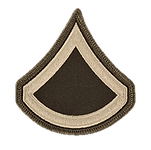
The E-3 Private First Class (PFC) is the third lowest rank within the unit and is given to members directly after completing the required training pipeline. the PFC will be expected to conduct remedial training, qualification courses, or conduct operations while following the orders of the Chain of Command appointed over them. This rank is still new in the Unit, but not Green.
Specialist

Description
A Specialist is a basic Soldier who has earned experience in Squad activities, participated in competitive combat operations, and is a proven asset to the Squad.
Corporal

Description
Corporal is not just a rank. It is the doorway to the NCO Corps. They are responsible for individual training, personal appearance and cleanliness of Soldiers. Corporals have established themselves as having leadership potential and are worthy of consideration as future squad leaders.
Sergeant

Description
The rank of Sergeant is the entree to a hallowed fraternity. Sergeants run the Army, and of that there can be no doubt. A Sergeant is a proven leader and can lead a Fireteam or even a Squad if necessary, as well as serve as a technical specialist in their MOS' and also as NCOIC of a DMOS. The Sergeant is where the axe meets the stone.
Staff Sergeant

Description
The Staff Sergeant is a proficient and reliable Squad Leader or senior technical specialist in their field. Their leadership is crucial to the health of the Division. Not only does the Staff Sergeant excel in Squad leadership, they also show the ability to assist the Platoon Sergeant or even serve as one if called upon.
Sergeant First Class

Description
The Sergeant First Class is the Platoon level NCO. He has proven himself not only an excellent Squad Leader in the past, but also an effective Platoon Sergeant. He has become a force to be reckoned with inside the Company and a trusted advisor and counselor to all junior NCOs and Enlisted soldiers. Sergeants First Class are the very definition of "Senior NCO".
Master Sergeant

Description
The rank of Master Sergeant says it all: Master of the art of leadership. The Master Sergeant serves as the principal NCO in staff elements at company and often higher levels. Although not charged with the enormous leadership responsibilities of the First Sergeant, the Master Sergeant is expected to dispatch leadership and other duties with the same professionalism and to achieve the same results as the First Sergeant.
First Sergeant

Description
When you are talking about the First Sergeant you are talking about the lifeblood of a Company. There can be no substitute of this position nor any question of its importance. When First Sergeants are exceptional, their units are exceptional, regardless of any other single personality involved. Perhaps their rank insignia should be the keystone rather than the traditional diamond. It is the First Sergeant at whom almost all unit operations merge. The First Sergeant is responsible for the welfare, discipline and training of all the Company's enlisted Soldiers and oversees most of the Company administrative, logistical and maintenance matters along with the XO.
Sergeant Major

Description
The Sergeant Major is the principal Senior NCO of the Battalion. With a background of excellence in all areas of leadership including Company First Sergeant, the Sergeant Major represents the height of accomplishment in the NCO Corps. The Sergeant Major can move mountains, part the skies and place his boot where he wishes.
Command Sergeant Major

Description
The Command Sergeant Major is the commanding senior NCO of a color-bearing Army unit (battalion or higher). With a background of excellence in all areas of leadership including Company First Sergeant, the Command Sergeant Major represents the height of accomplishment in the NCO Corps. The Command Sergeant Major is a beast of his/her own and not to be trifle with.
Warrant Officer one

Description
Appointed by warrant from the Secretary of the Army, Warrant Officer 1's are technically and tactically focused officers who perform the primary duties of technical leader, trainer, operator, manager, maintainer, sustainer, and adviser.
Chief Warrant Officer two

Description
Chief Warrant Officers become commissioned officers by warrant as determined by the President of the United States. Chief Warrant Officers are intermediate level technical and tactical experts who perform increased duties and responsibilities at the detachment through battalion levels.
Chief Warrant Officer three

Description
Advanced-level experts who perform the primary duties that of a technical and tactical leader. They provide direction, guidance, resources, assistance, and supervision necessary for subordinates to perform their duties. CW3s primarily support operations levels from team or detachment through brigade.
Chief Warrant Officer four

Description
Senior-level experts in their chosen field. They primarily support battalion, brigade, division, corps, and echelons above corps operations. CW4s typically have special mentorship responsibilities for other WOs and provide essential advice to commanders on WO issues.
Chief Warrant Officer five

Description
Master-level technical and tactical experts that support brigade, division, corps, echelons above corps, and major command operations. They provide leader development, mentorship, advice, and counsel to WOs and branch officers. CW5s have special WO leadership and representation responsibilities within their respective commands.
Second Lieutenant

Description
As the PV2 is the junior Soldiers and the CPL is the junior NCO, the Second Lieutenant is a junior Commissioned Officer, learning what it means to no longer wear stripes. Second Lieutenants are freshly minted Platoon Leaders, and do well to take heed the advice of the First Sergeant and also their Platoon Sergeant. They also have a seat at the table of Command Staff, but also do well to listen more than speak.
First Lieutenant

Description
The First Lieutenant has proven him/herself as a competent Platoon Leader and a trusted part of Command Staff. He has earned the confidence of his Soldiers and continues to improve his Platoon, Company and the Division as a whole.
Captain

Description
To be promoted to Captain is to be the standard of excellence as a Company Commander and an Officer. The Captain enjoys universal respect from his Soldiers and fellow Officers and has made the Division a better place because his Company has been made ever stronger